
Urgent care runs on volume. Every extra click, every screen that loads slowly, every field that doesn’t carry forward costs you time you don’t have. PracticeStudio was built to keep up — nurse entry, guided intake workflows, stacked blueprints, and Alma AI — so the note is done before the next patient is roomed.
See Alma AIWe haven’t just built urgent care software from the outside looking in. We’ve spent years working directly inside urgent care operations — on the floor, in the workflow, where the pace is real and the margin for error isn’t. That experience is baked into every part of how PracticeStudio handles urgent care.
Urgent care lives and dies by throughput. If the documentation workflow slows down patient flow — a slow screen, an extra step, a field that doesn’t carry forward — the entire practice feels it by the end of the shift. The software has to get out of the way.
You don’t know who’s walking through the door or what’s in their chart until they’re already in the room. The intake workflow has to capture everything needed for the visit — fast — before the provider sees them.
Catch-up charting at the end of a shift is a morale killer and a liability risk. The documentation workflow has to keep pace with the visit, not trail behind it.
Before the provider sees the patient, the nurse runs through a structured entry blueprint — vitals, past history, review of systems, chief complaint. Every required field prompted. Nothing left to sticky-pad notes.
One button walks staff through every required field in sequence. The progress counter tracks completion so nothing gets overlooked during a fast-paced shift — even when the waiting room is full.
Combine a nurse entry blueprint with an acute care blueprint and the data carries forward. Vitals captured by the nurse appear in the provider’s encounter automatically. No reentry. No gaps.
Patients complete intake before they reach the desk. Their responses feed directly into the encounter — no retyping, no paper forms to scan later, no bottleneck at the front desk.
Sore throat. Nasal congestion. Cough. Chest tightness. Fever. Shortness of breath. A typical urgent care respiratory visit doesn’t present with one complaint — it presents with six. Alma captured all of them, each SNOMED coded to the correct system, plus a complete HPI documenting how the illness progressed day by day. The provider stayed focused on the patient. The note was ready when they moved to the next room.
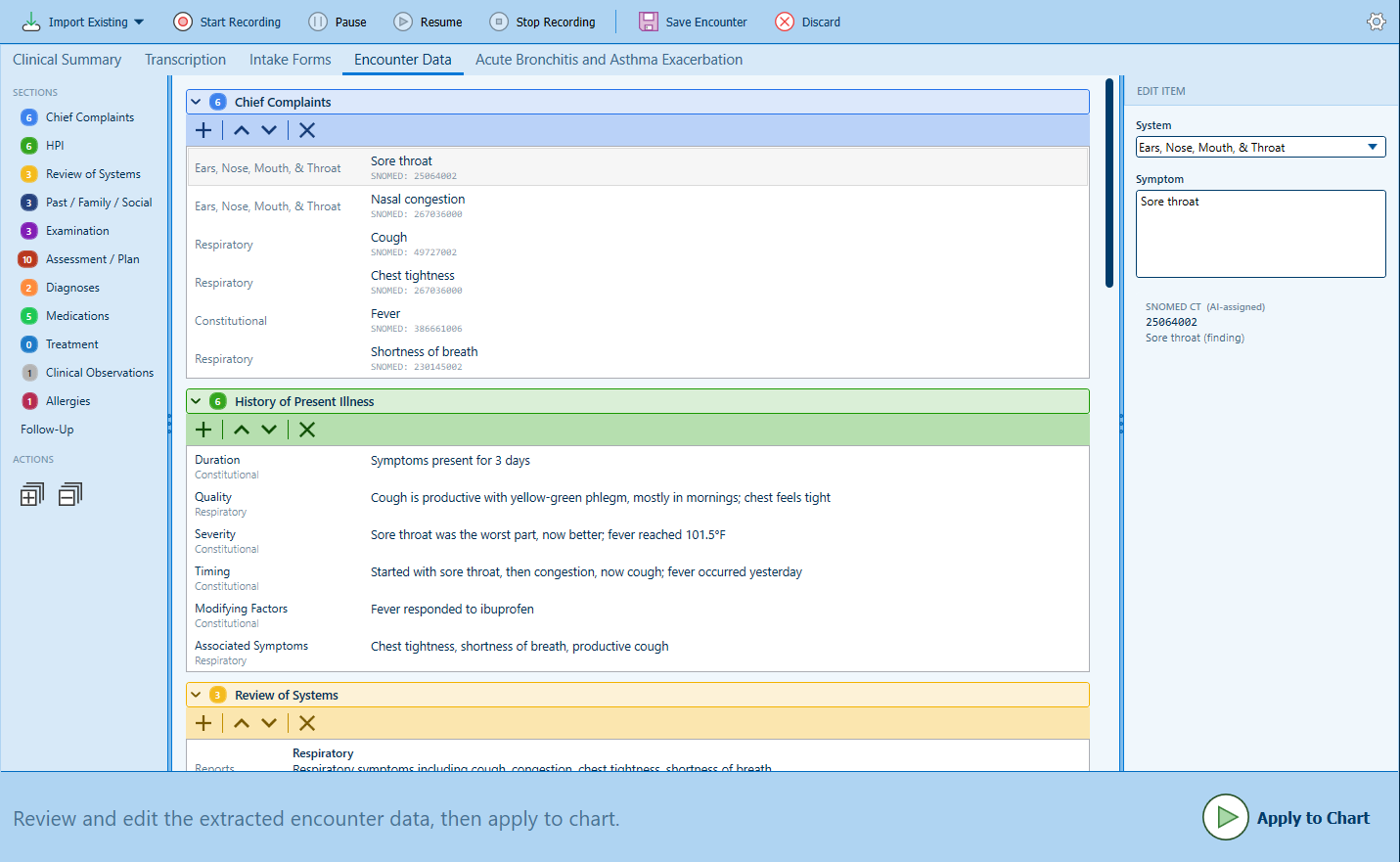
Six chief complaints across three systems, all SNOMED coded. Disease progression documented in the HPI. All from a single ambient recording during the visit.
We’ll walk through a full patient flow — nurse entry through provider sign-off — at the pace urgent care actually runs.