
Dermatology demands more than a general-purpose EHR. Body diagram exams, injection mapping, serial lesion tracking, a dedicated cancer log — PracticeStudio was built for the full scope of modern dermatology, medical and cosmetic alike.
See Alma AIMicroFour has served dermatology practices for decades. The specialty changed — cosmetic procedures grew alongside medical dermatology, EHR requirements multiplied, and the tools providers needed evolved with them. We changed with it. What we built for dermatology today reflects years of listening to what the specialty actually needs — not a general-purpose EHR stretched to fit skin.
“Rash on the arm” is not a clinical record. Dermatology demands location, size, morphology, characteristics, and a body map — captured consistently, every visit, every patient. Text boxes don’t cut it.
Neurotoxin units mapped to a face diagram on Tuesday. A suspicious lesion biopsy on Thursday. Your software needs to handle both without switching modes or cobbling together workarounds.
When you flag something suspicious, that finding needs to follow the patient for years. Serial-numbered, tracked, visible at every visit. Nothing can fall between appointments when the stakes are this high.
Touch to place findings on an interactive body diagram. Location becomes part of the structured record — not a description someone has to interpret later.
Place neuromodulator or filler units directly on a face diagram. Unit counts, product, treatment sets — the procedure note builds as you work.
Suspicious findings get a serial number and a longitudinal tracking record the moment they’re flagged. The cancer log captures biopsy dates and classifications, accessible from anywhere in the chart.
E/M codes update in real time as the encounter builds. Complexity drives the code automatically — no separate coding step, no second-guessing.
A suspicious pigmented lesion on the left forearm. Present for three months, growing, changing color, bleeding on trauma. Mother had melanoma removed in her 40s. Alma captured all of it — system identified as Integumentary, SNOMED coded, anatomy precise to the centimeter, family history filed correctly — through ambient audio, without a single click during the exam.
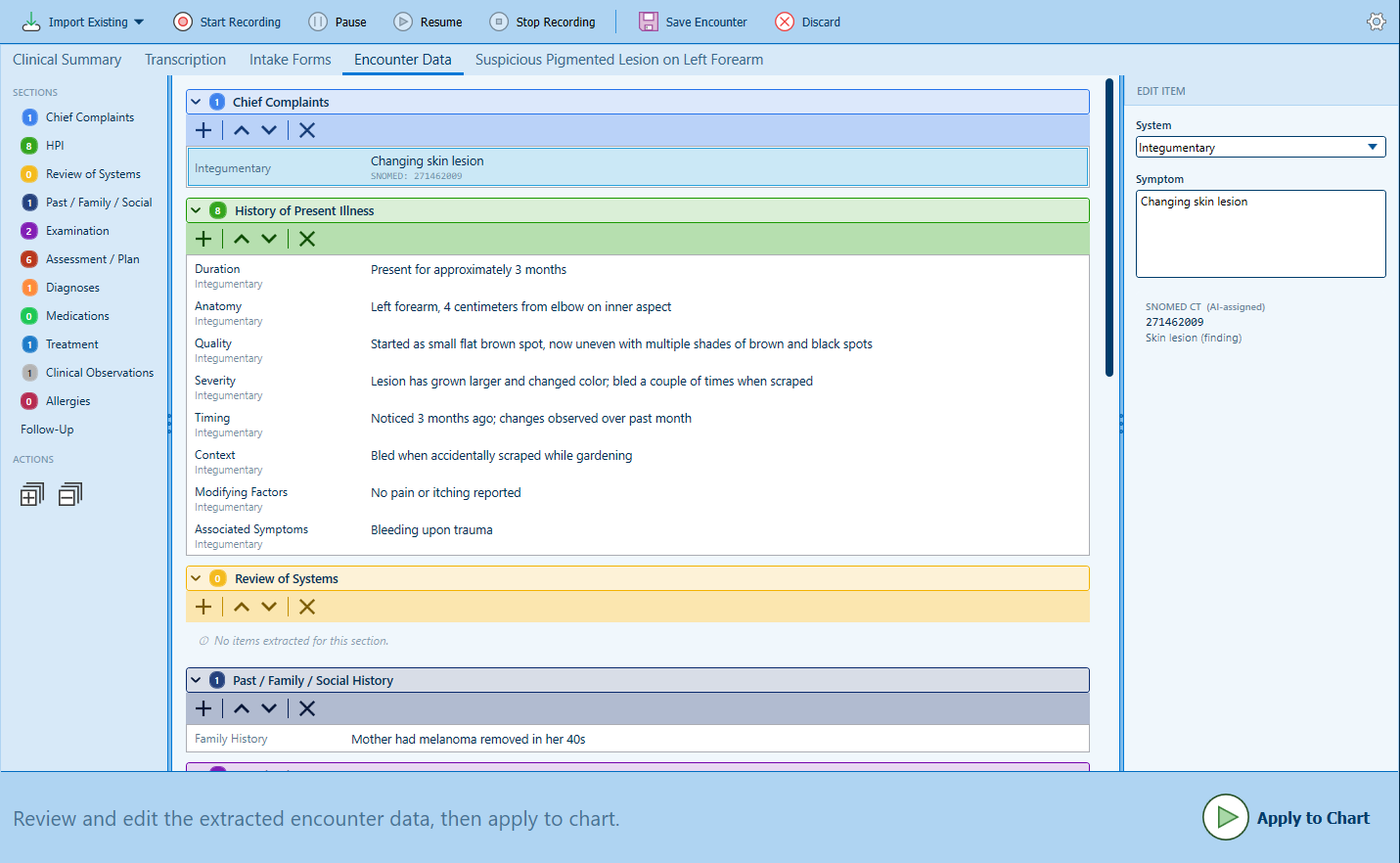
The AI Workflow Encounter Data tab — Integumentary system, SNOMED coded, eight HPI fields populated, family history filed correctly. All from a natural conversation during the visit.
Body diagram exam, injection mapping, lesion tracking, Alma AI — all of it, live, built around a real dermatology workflow.