
Family practice covers more ground than any other specialty. From newborn weight checks to chronic disease management — three conditions in one appointment, every appointment. PracticeStudio was built for all of it.
See Alma AISome relationships start as business. A few become something else entirely. The family physicians who helped us build PracticeStudio weren’t just customers giving feedback — they were people who trusted us with their practice, taught us what the software needed to do, and became part of our story. That kind of relationship changes how you build things. We haven’t forgotten it. We don’t intend to.
One patient. Three active conditions. A rash that showed up last week and an immunization that’s overdue. Family medicine covers more clinical ground in a single encounter than most specialties see in a week. Generic templates weren’t built for this.
Your diabetic patients come in regularly. You need to see the trend, not just the moment — A1C history, medication changes, lab patterns over time. Disconnected notes don’t tell that story. A longitudinal chart does.
Overdue labs. Pending referrals. Immunizations due. Family medicine carries more ongoing patient obligations than almost any other specialty. When something slips through, a patient pays for it.
Constitutional, cardiovascular, respiratory, gastrointestinal, neurological, psychiatric — every system family practice touches, organized by workflow, accessible in a single click.
Labs due appear in the encounter sidebar the moment a visit opens. Providers see what needs attention before the patient leaves — no separate tracking list, no chasing results.
CDC percentile curves for weight, height, and BMI — plotted from vitals captured during the visit and tracked across every well-child encounter in the patient’s history.
Write and manage prescriptions without leaving the encounter. Medication history stays connected to the patient record, not isolated in a separate application.
The patient came in for lower back pain. In the course of the visit she also described numbness in both feet, a tingling sensation, and pain in one toe. Alma captured all four — each assigned its own SNOMED code, each attributed to the right body system — and built out a six-field History of Present Illness alongside the active problem list. From a single ambient recording. The provider stayed with the patient.
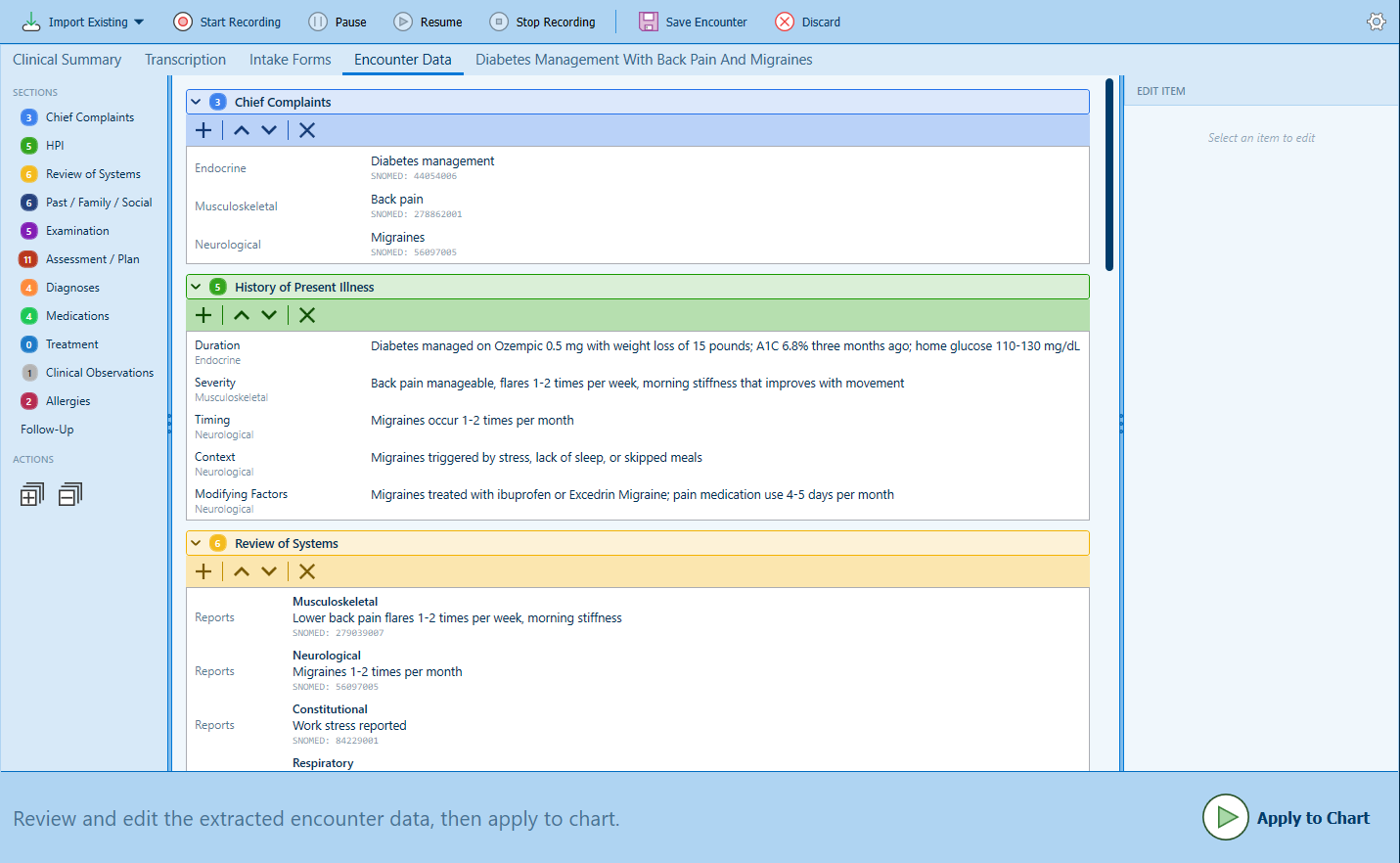
Four chief complaints. Four SNOMED codes. A History of Present Illness broken into six discrete clinical fields — all from a single ambient recording during the visit.
We’ll walk through a multi-condition encounter — chronic disease management, pediatric charting, Alma AI — built around the real breadth of what your practice handles every day.